


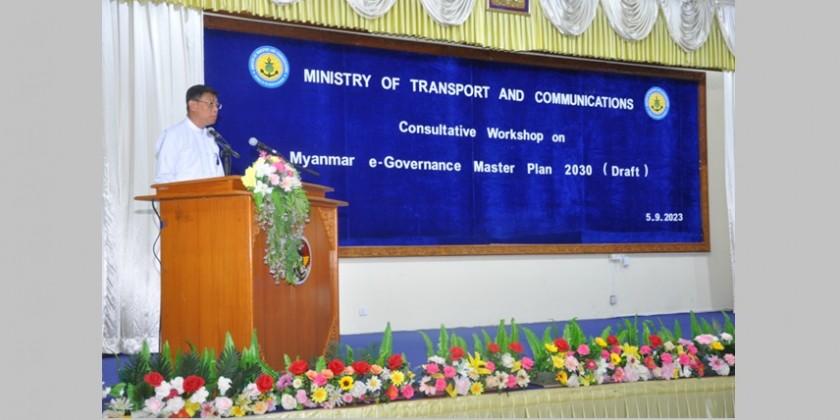
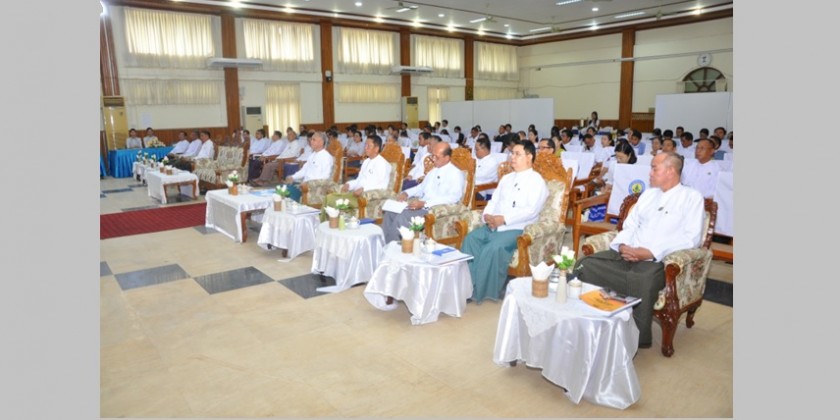
A workshop on “Consultative Workshop on Myanmar e-Governance Master Plan 2030 (Draft)" was held at the Ministry of Transport and Communications in Nay Pyi Taw on Tuesday with the aims for implementing e-Government in Myanmar by government organizations involving Government Administrative Mechanism and relevant Ministries.
At the event, member of the State Administration Council Deputy Prime Minister Union Minister for Transport and Communications General Mya Tun Oo said that in order to achieve Myanmar's Digital Transformation, efforts must be made to achieve e-Government.
Today, most of the world's nations have gone beyond e-Government and are moving towards Digital Government and Myanmar must also approach Digital Government since now. In order to do that, one of the main requirements is to establish a National Strategic Vision for the entire nation.
To catch up the Digital World and New Digital trends which are rapidly progress in the world, the previous e-Governance Master Plan has been amended and the Myanmar e-Governance Master Plan 2030 has been drafted.
In the draft, the goals, aims, strategies and frameworks have been developed and the action plans to be carried out in the short and long-term period until 2030, technical infrastructure that should be built and ICT Law, policy, guideline and norms that should be drafted are fully added.
He expressed his belief that the workshop will bring good recommendations and results on the Myanmar e-Governance Master Plan 2030 (Draft) which is an important plan for national development.
After that, the Director of e-Government Division of the Information Technology and Cyber Security Department reported on work programs including in the draft and the Chief Information Officers (CIO) of Government Organizations made recommendations.
The workshop was attended by Union Ministers from relevant Ministries, deputy Ministers, permanent secretaries, concerned officials and the Chief Information Officers (CIO) of Union Level Organizations, Union Ministries, Nay Pyi Taw Council and region and state governments.